
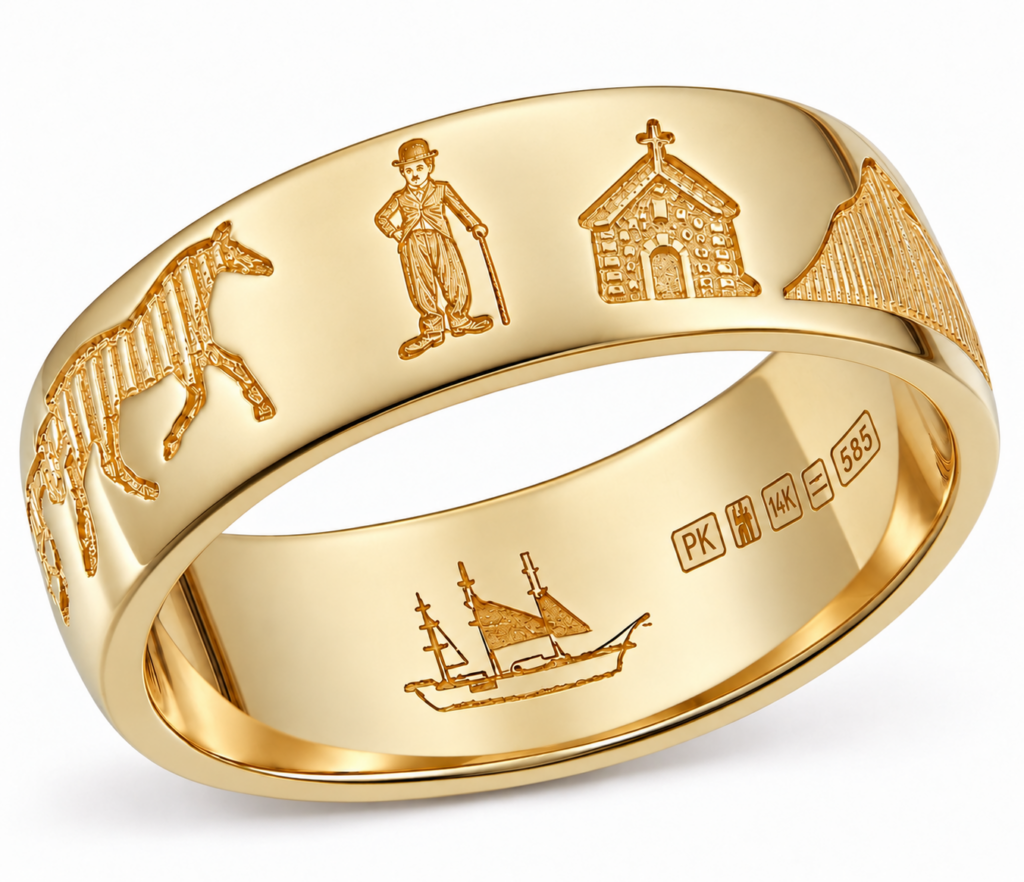
The seven symbols of Ring of Kerry Jewellery tell the story of a homeland. Around the ring and across the pendants are reminders of Kerry’s landscape, faith, wildlife, traditions and people. A further engraving, quieter and more personal, gives that story another dimension: the emigration ship inside the ring and on the backs of the pendants.
Together, the symbols and the ship connect a place with the people who left it. They invite us to remember Ireland’s emigrants, especially those driven from home during the Great Famine, and the heritage that continued to matter across the sea.
Created by Paul Kennedy, the collection brings these connections into jewellery that can be worn close to the body and passed from one generation to the next. Its story is about both belonging to a place and keeping that belonging when distance separates us from it.
The Emigration Ship: A Quiet Memorial
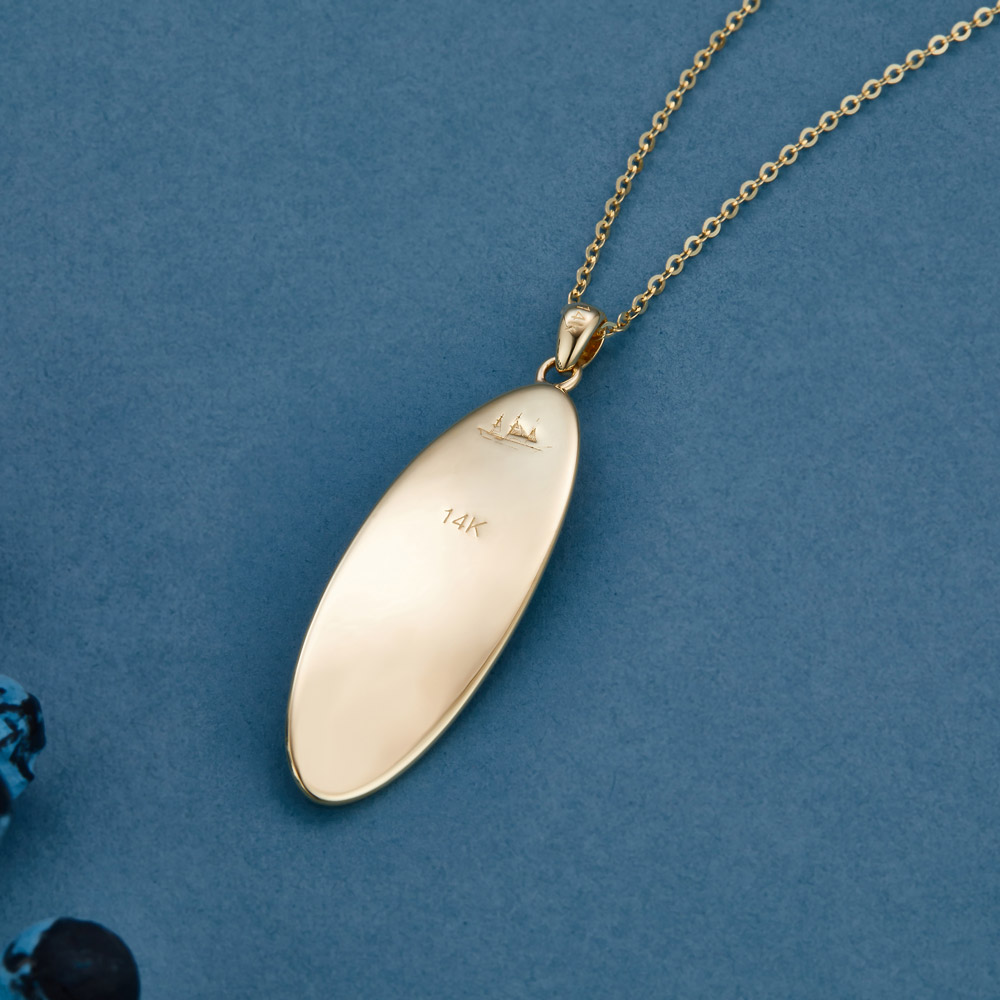
The sailing ship is engraved on the inside of the Ring of Kerry rings and on the reverse of the pendants. Its position gives it an intimate quality. The outward-facing symbols celebrate Kerry; the ship brings us closer to the personal history of leaving, separation and remembrance.
Our original account of the Ring of Kerry collection describes the ship as a memorial to those who had to emigrate from County Kerry. In this article, that remembrance reaches into the wider Irish experience of the Great Famine and its long aftermath.
For a wearer whose family left Ireland, the engraving may suggest a particular ancestor. For another, it may honour the many journeys whose details have been lost. A name, a port or a departure date may no longer be known, but the family’s connection with Ireland can remain.
The engraved vessel is a symbol of emigration and remembrance. Its meaning does not depend on identifying it with a named historical ship. It holds space for many different lives and journeys.
The Great Famine and the Experience of Leaving
The Great Famine, or An Gorta Mór, devastated Ireland between 1845 and 1852. The National Archives’ Famine records preserve letters, reports and petitions from communities pleading for help.
The National Museum of Ireland explains how potato blight and insufficient alternative food supplies produced destitution, death and a sharp increase in emigration. The Famine intensified an existing history of migration, and departures continued long after its worst years.
Leaving was often a response to desperate circumstances. Families faced hunger, insecurity and the loss of livelihoods. Reaching another shore could offer a chance of survival, but it also meant separation from relatives, neighbours and familiar places.
The journey itself could bring further hardship. The museum’s account of emigrant voyages records routes through Liverpool, crossings to North America and the dangerous conditions experienced by some passengers. It also describes letters, money and prepaid tickets sent home, helping relatives and making further journeys possible.
Remembrance must make room for loss as well as survival. The ship engraving can honour those who reached a new home, those who died and the families left behind. Their experience deserves to be remembered in its full human weight.
Seven Symbols of the Homeland
The collection brings together different periods of Kerry’s story. Its early monastic heritage sits beside longstanding local customs, architectural landmarks and more recent connections. The symbolic links below are our interpretation of what these motifs can mean when worn alongside the emigration ship.
1. The Jaunting Car — The Roads and People of Home
The horse-drawn jaunting car recalls Killarney and the experience of travelling through its surroundings. It brings the story to the scale of a road, a conversation and a journey shared with other people.
Beside the emigration ship, it can represent the familiar world from which a longer journey began. The carriage and the vessel belong to different kinds of travel, joined here by the memory of place.
2. King Puck — Tradition and Gathering
The crowned goat connects the collection with Puck Fair in Killorglin. It honours a local tradition built around gathering, recognition and community.
For someone living overseas, a remembered custom can keep home present. King Puck offers a reminder of the shared occasions through which a community recognises itself, and of the stories people can continue to tell far from Kerry.
3. Skellig Michael — An Older Ireland
Skellig Michael takes the story back to Kerry’s early Christian heritage. The island’s monastic remains are recognised on the UNESCO World Heritage List.
The rock rising from the Atlantic connects land, sea and the determination to make a life in a demanding landscape. Alongside the ship, it offers an image of the homeland held in memory beyond the horizon.
4. The Beehive Huts — Shelter, Faith and Endurance
The stone beehive huts recall the shelters of the early monks, particularly those associated with Skellig Michael. Their compact forms make an ancient connection with shelter and spiritual life visible in the jewellery.
Within this article’s interpretation, they speak to the human need for a home and a place of belonging. Their history is distinct from the Famine, but the ideas of shelter, faith and endurance give them a meaningful place beside the memorial ship.
5. The White-Tailed Eagle — Freedom, Renewal and Return
The white-tailed eagle represents Kerry’s wild landscape and the bird’s return to Ireland. In the collection, it suggests freedom, resilience and renewal.
Set beside the ship, the eagle can also invite thoughts of return: revisiting an ancestral place, reconnecting with relatives or discovering a family story. That is a personal symbolic connection, rather than a claim that the eagle engraving originated during the Famine.
6. Charlie Chaplin — Welcome and Lasting Affection
Charlie Chaplin’s connection with Waterville began with his family’s visit in 1959. His familiar bowler hat and cane bring a later chapter to the collection: the affection a visitor can develop for Kerry.
This motif makes room for humour, creativity and shared memories. In a design concerned with belonging, Chaplin’s connection with Waterville reminds us that a bond with a place can also be formed through welcome and the wish to return.
7. Church and Cathedral — Community and Continuity
The church symbol honours Kerry’s churches, with St Mary’s Cathedral in Killarney as a landmark example. These buildings connect faith and architecture with the events of family and community life.
Beside the ship, the motif can recall the communities from which people departed and the bonds they sought to keep. It may also bring to mind the faith and support through which families found strength while adapting to new surroundings.
The Symbols Outside, the Ship Within
The design can be read as two connected stories. The seven Kerry symbols give shape to the homeland; the ship commemorates the journey away from it. On a ring, that relationship sits between the outer band and the inner surface. On a pendant, it appears between the visible face and the reverse resting close to the wearer.
The National Famine Commemoration’s account recognises the lasting influence of the Famine on emigration, diaspora communities and Irish cultural memory. Our jewellery offers a small, personal way of engaging with that remembrance.
A piece worn today is a contemporary expression of heritage. We do not need to imagine that these particular designs were carried aboard Famine ships to understand their meaning now. They allow descendants and wearers to honour earlier lives while expressing their own connection with Kerry.
A Connection to Carry Forward
Family history may begin with a story told at home, a name in a record or a visit to an ancestral townland. The ship and the seven symbols can become a prompt for those conversations: who left, who stayed and what has been remembered.
Whether worn in Kerry or across the world, the collection celebrates a connection that distance need not erase. Explore the seven symbols and the Ring of Kerry Jewellery collection, and discover the story you wish to carry forward.